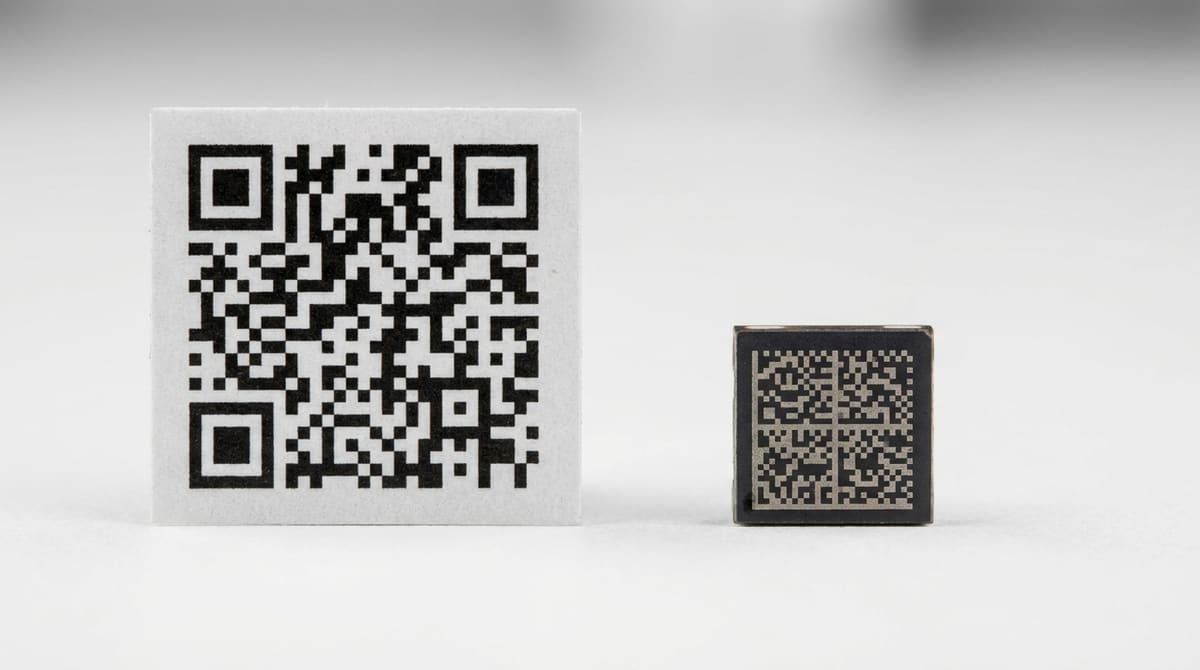
QR code has become the generic name for "square scannable pattern," but it's actually just one type of 2D barcode among several. Data Matrix is the other one most people run into without realizing it, stamped on pill bottles and tiny electronic components. They look similar at a glance and both pack far more data than a 1D barcode, but they solve different problems.
Generate a standard QR code
Open QR Code Generator — Free, No SignupWhat Both Formats Have in Common
QR codes and Data Matrix codes are both classified as 2D (matrix) barcodes, meaning they store data across a two-dimensional grid of squares instead of a single row of parallel lines. That grid structure is what lets both formats hold vastly more information, and survive far more physical damage, than a traditional 1D barcode reading in only one direction.
The Real Differences That Matter
- Size at the same data capacity: Data Matrix can encode the same amount of data in a noticeably smaller physical footprint, which is exactly why it's the standard on tiny components and medical vials where a QR code simply wouldn't fit.
- Reader compatibility: Every modern smartphone camera reads QR codes natively with no app required. Data Matrix codes usually need a dedicated industrial scanner or a specific scanning app, not a plain phone camera.
- Where each is standard: QR dominates consumer-facing uses, marketing, menus, payments. Data Matrix dominates manufacturing, pharmaceuticals, and aerospace part-marking, environments with dedicated scanning equipment already in place.
Why QR Code Won the Consumer Space
The deciding factor wasn't technical superiority, it was native camera support. Once smartphone cameras started recognizing QR codes automatically without a separate app, QR became the only 2D format an ordinary customer could scan with what they already had in their pocket. Data Matrix never got that same default camera recognition, so it stayed confined to settings where a dedicated scanner was already part of the workflow.
Build a scannable QR code for your use case
Open Custom QR Code Builder — FreeWhich One You Actually Need
For nearly anything aimed at a customer, a menu, a business card, a poster, a payment link, QR is the right and only practical choice, since it's the one format a phone reads instantly. Data Matrix only makes sense if you're labeling extremely small items, or you're working inside an existing industrial system that already scans it, both fairly specific situations most small businesses never run into.
There Are Other 2D Formats Too, Less Common Ones
QR and Data Matrix are the two you'll actually run into, but a handful of other 2D formats exist for narrower use cases, Aztec Code on airline boarding passes, PDF417 on the back of a driver's license. Each was designed around a specific constraint, print space, scanner type, damage tolerance, the same way Data Matrix was, which is really the pattern worth remembering: the "right" 2D format has always been a function of the environment scanning it, not one format being universally better.
None of these narrower formats are worth chasing for a typical small business or marketing use case. If your audience is holding an ordinary smartphone, QR remains the only format that scans instantly with no extra app or hardware, which settles the choice before the comparison even gets interesting.
The one exception worth remembering is scale: if you're labeling something physically tiny, a component, a small vial, a jewelry tag, and QR simply won't fit legibly at that size, that's the specific case where it's worth looking into Data Matrix or another compact format instead, rather than shrinking a QR code past the point it can reliably scan.
Frequently Asked Questions
Can a regular phone camera scan a Data Matrix code?
Some camera apps can with the right settings, but it isn't the automatic, no-app experience QR codes get by default, which is the main practical gap between the two formats.
Is Data Matrix more secure than a QR code?
No, neither format includes encryption on its own. Both simply store data, and security depends entirely on what that data points to or contains, not which 2D format was used.
Why do pill bottles use Data Matrix instead of QR?
The available label space is tiny, and Data Matrix packs the required tracking data into a smaller footprint than a QR code would need for the same amount of information.
Is a Data Matrix code the same thing as a barcode?
It's technically a type of barcode, but a 2D one, distinct from the classic 1D striped barcode most people picture, which can only read in a single direction and holds far less data.
Related tools
- QR Code Generator: Create a standard QR code for any everyday use
- Custom QR Code Builder: Add a logo and brand colors to your code